Chinese-origin assets are flowing into American pipelines at scale, and the US innovation system converts money and time into approved medicines slower and more expensively than its main competitor. Congress is drafting legislation to restrict Chinese drug licensing. Policymakers are chasing the visible symptom and ignoring what’s actually causing it.
The Numbers Behind China’s Rise
In 2015, Chinese out-licensing deals numbered roughly 5, worth around $2.5 billion. By 2025, that grew to 157 deals worth approximately $135–136 billion, a near-tenfold jump in value over 2024 alone, according to industry deal trackers including PharmCube and NextPharma.
The acceleration has been steep. In the first half of 2025, US companies signed 14 China-licensed deals worth roughly $18.3 billion. In the same period of 2024, they signed 2.
And the quality of these assets is rising with the price. According to data from Evaluate, average upfront deal values surged 230% over the past four years, from $52 million in 2022 to $172 million in early 2026. Average total deal size in early 2026 reached around $1.3 billion, a 76% increase over the 2025 average. Industry analysts now say plainly that China is no longer a bargain basement.
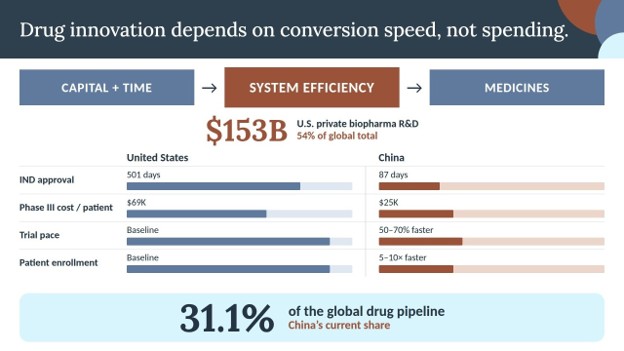
China now accounts for roughly 30% of the global drug pipeline, ranking second behind the US. Three Chinese firms sit in the top 20 global pipelines by size: Hengrui at number 12 with 178 drugs, Sino Biopharmaceutical at 15, and CSPC at 16.
In antibody-drug conjugates, over 50% of global clinical-stage ADC programs are run by Chinese developers. By 2025, advanced modalities like cell and gene therapies made up nearly half of Chinese deal volume. This is high-complexity science, and the market responded accordingly.
Why It Happened: A System Built for Speed
None of this happened by accident. China redesigned its system starting in 2015:
-
- Regulatory reform: IND approval times fell from 501 days to 87 days.
-
- Trial capacity: China’s share of global innovative drug trials grew from 5% in 2016 to 30% in 2025, nearly matching the US at 33%.
-
- Cost structure: Phase I trials cost 43% less and run in half the time. In Phase III non-small cell lung cancer trials, direct cost per patient runs about $25,000 in China versus $69,000 in the US.
-
- Fiscal design: a 200% R&D super-deduction, a 15% corporate tax rate versus 25%, science parks, and talent programs that reversed the brain drain.
-
- Government investment: roughly $110 billion in 2023, against $65 billion in US government intramural spending.
The deal structures evolved too. The NewCo model lets a Chinese firm spin assets into an offshore joint venture, take cash plus an equity stake usually under 20%, and let Western investors fund development. The Chinese licensor keeps long-term upside while sidestepping foreign investment hurdles.
Then came the mega-deals that got Washington’s attention: AstraZeneca’s obesity drug deal with CSPC, worth up to $18.5 billion, and AbbVie’s cancer-focused agreement with RemeGen, valued at up to $5.6 billion. Once numbers reach that scale, legislation follows.
Washington’s Response: Regulatory Rules and Data Restrictions
The policy response is moving on three parallel tracks and clinical data restrictions.
The BIOSECURE ACT
The BIOSECURE Act became law on December 18, 2025 inside the National Defense Authorization Act (NDAA). It bars federal procurement from designated biotechnology companies of concern. It targets manufacturing and CDMOs, and that matters because roughly 120 US drugs rely on Chinese CDMOs and 79% of surveyed biopharma companies hold at least one China-linked CDMO contract.
Notably, BIOSECURE left licensing untouched. That’s exactly what the next two tracks aim to address.
The COINS ACT
The COINS Act, or Comprehensive Outbound Investment National Security Act, became law as part of the FY2026 NDAA in December 2025. It codifies and expands a Treasury screening system designed to prohibit, or require notification of, US investments in sensitive foreign sectors. As enacted, it covers semiconductors, AI, quantum computing, hypersonics, and supercomputing. Biotechnology is not on that list.
What COINS does is create two tiers of transactions: prohibited ones that cannot proceed, and notifiable ones that must be disclosed to Treasury before closing. The investment types covered include equity backing, debt financing, and option and warrant structures. Pure licensing deals without any equity component fall outside the current text. That distinction matters a lot for how most China-to-US drug licensing actually works today.
Section 809 of the COINS Act authorizes the Treasury Secretary to add additional technology categories that enable the military, intelligence, surveillance, or cyber capabilities of a country of concern, without needing new legislation. Republican lawmakers from the House Foreign Affairs Committee and the House Select Committee on China have both sent letters to Treasury Secretary Bessent urging him to use that authority to add biotechnology. Treasury has not publicly signaled any intention to do so, and time is running short: the initial COINS Act rules need to be finalized by March 13, 2027.
Where COINS does directly bite today is on NewCo structures. When a Chinese firm retains an equity stake in an offshore joint venture, even a minority position under 20%, that equity component can bring the transaction within COINS’ covered transaction framework. The joint venture itself sits at the core of what the statute was designed to reach.
The BINSA
BINSA, the Biotech Investment National Security Act, was introduced in the House on June 2, 2026 by Representatives Moolenaar and Dingell, with a Senate companion introduced by Senators Ricketts and Slotkin on August 6, 2026. The bipartisan, bicameral momentum is notable.
BINSA is structured as a direct amendment to COINS. It would add biotechnology, specifically pharmaceutical and biological product development, to the list of covered sectors. Once added, US pharmaceutical licensing deals, joint ventures, and equity investments with Chinese-covered foreign persons would be subject to Treasury Department review.
The bill’s scope is broad. It explicitly covers:
-
- Licensing deals involving technology and intellectual property, including drug discovery platforms and know-how
-
- Joint ventures where clinical development capabilities or manufacturing expertise could transfer to a PRC-directed or PRC-controlled entity
-
- Equity investments in Chinese biotech
-
- Biologics manufacturing collaborations
Notably, agricultural biotechnology, industrial fermentation, and basic academic research are excluded. But pharmaceutical development, clinical R&D, and biologics manufacturing are squarely in scope.
BINSA also instructs Treasury to issue implementing regulations within one year of enactment, in consultation with HHS, the Department of Defense, and the Director of National Intelligence. And it requires the Secretary of Defense to separately assess within 60 days whether US capital flows into Chinese biotech create national security risks.
The key practical question is what “review” actually means in practice. COINS operates on two tiers: transactions can be prohibited outright, or they can be notifiable, meaning they must be disclosed and can be scrutinized but are not automatically blocked. Where any given licensing deal lands on that spectrum would depend on the implementing regulations, which do not yet exist.
As written, BINSA is prospective. Pre-existing deals are likely protected; the COINS Act expressly excludes transactions completed before enactment, and well-settled administrative law supports prospective-only application. But milestone payments, follow-on tranches, and data-sharing under existing agreements can still draw scrutiny, because those may constitute new transactions rather than continuations of old ones.
BINSA also needs a must-pass legislative vehicle. The BIOSECURE Act got across the line through the NDAA. That creates a real threat window at every defense authorization cycle, and the Senate companion means it now has bicameral pressure behind it.
FDA Data Restrictions
The House FY2027 FDA appropriations bill would bar FDA from accepting Chinese clinical trial data for IND applications, with a one-year transition.
This one deserves more attention than it’s getting. A deal can survive BINSA and still lose its economic rationale here, because an asset whose data can’t support FDA approval is worth a fraction of its purchase price.
The most likely near-term outcome under COINS is a notification pathway rather than an outright ban. Notification still creates friction, a chilling effect, and a stepping stone to prohibition. A September 2026 Reuters report indicates the administration is working toward a framework that preserves most licensing deals while restricting pathogens and weaponizable technologies, after heavy pharma lobbying against broad curbs.
Efficiency, not more Protectionism and Funding
The dominant narrative blames lack of funding for the US Biotech lack of competitiveness with China. The numbers don’t support that.
US private-sector biopharma R&D reached $153 billion in 2024, 54% of the global total. The NIH budget stands at $47.7 billion. The US already outspends every other country by a wide margin.
The actual problem is how the money gets used, not how much there is.
Chinese firms invest around 10% of revenue in R&D versus 20% for Western firms, yet they get comparable or better output per dollar. Every $100,000 in R&D supports 1 US worker versus 2.3 Chinese workers. Trials run 50 to 70% faster. Patient enrollment moves 5 to 10 times faster at Chinese hospitals. IND approval takes 87 days, down from 501 days before 2015 reforms.
Meanwhile the US clinical trial system is structurally broken. Twenty percent of trials fail to recruit the required participants. Phase I work is shifting to Australia. Proof-of-concept studies are moving to China. Even the FDA concedes the point:
The FDA acknowledged that a growing share of Phase 1 clinical trials moving overseas is delaying opportunities for American patients and weakening the nation’s position as a global leader in biomedical research, prompting Operation Trailblazer to reverse the trend.
The cost of clinical trials in the US has become untenable ($400,000 for an oncology patient) and payments to fast track recruiting pose ethical questions.
Companies license Chinese assets because the US system makes domestic sourcing slower and more expensive at every stage. Restricting those licenses thins American pipelines while leaving every friction point intact.
Three Recommended Changes
Restricting Chinese licensing without fixing the underlying system just thins American pipelines. The fixes required are structural, and they cut across the full value chain from target identification to patient access.
1. Deploy AI Across the Full Drug Development Value Chain
The productivity math on traditional drug development is brutal. Bringing a new molecular entity to market costs on average $2.8 billion, accounting for the cost of capital and the failures that subsidize every approval. Only about 12% of drugs that enter clinical trials reach approval. A failed late-stage trial costs between $800 million and $1.4 billion in sunk costs alone.
AI changes each stage of that math differently, and the opportunity is largest where the losses have historically been deepest.
-
- Target identification and molecule design. Insilico Medicine identified a novel target for idiopathic pulmonary fibrosis and advanced a candidate into preclinical trials in 18 months at a reported cost of $150,000, a process that typically consumes four to six years and tens of millions of dollars. AI-originated compounds now show an 80–90% Phase I success rate compared to 40–65% for conventionally developed drugs. Better target validation upstream means fewer expensive failures downstream.
-
- Predictive modeling in early-stage trials. Phase I and Phase II trial design should be rebuilt around AI-driven adaptive protocols. Validated biomarkers, mechanistic receptor pharmacology models, and AI-generated dosing predictions can replace much of what a second large-scale trial was historically needed to establish. This is the scientific logic behind the FDA’s February 2026 announcement moving to a single pivotal Phase 3 trial as the new default standard. As the FDA’s draft guidance frames it, one adequate and well-controlled investigation plus confirmatory evidence, including real-world outcomes and validated biomarkers, now satisfies the substantial evidence standard. Sponsors who still scope their programs around two Phase 3 trials are carrying infrastructure the regulatory framework no longer requires.
-
- Patient recruitment. Twenty percent of US trials fail to meet enrollment targets. AI-driven patient identification using electronic health records, claims data, and genomic registries is already demonstrating enrollment compression of 50% or more in early deployments. The AI in clinical trials market was valued at $2.76 billion in 2024 and is on track to reach $54.8 billion by 2032, reflecting how fast the field is moving. This is exactly where the US can close the enrollment speed deficit with China without moving trials offshore.
-
- Clinical operations and safety monitoring. AI-assisted adverse event detection, protocol deviation flagging, and real-time data quality monitoring reduce site burden and accelerate data lock. Regulatory document assembly, including IND applications, is already being automated. The FDA has reviewed over 500 AI-related submissions since 2016 with a 95%+ acceptance rate. The regulatory infrastructure for AI-assisted trials exists. The adoption curve just needs to accelerate.
-
- Manufacturing and supply chain. AI-driven process optimization, real-time batch release evaluation, and supply chain planning tools are reducing production variance and lot release timelines. For a sector trying to build domestic CDMO capacity as an alternative to Chinese manufacturing, AI-optimized domestic production economics matter.
-
- Post-market pharmacovigilance. Real-world evidence generated from claims data and patient registries, analyzed by AI, can supplement clinical trial data, support label expansions, and in some cases substitute for confirmatory studies under accelerated approval frameworks. The FDA’s Real-World Evidence program creates a legitimate pathway for this. It should be used more aggressively.
The FDA and EMA published joint guiding principles for AI practice in medicine development in January 2026, covering the full product lifecycle. The regulatory framework is moving. Industry adoption needs to match it.
2. Fix the Gross-to-Net Problem
The pricing debate in US biopharma focuses almost entirely on list prices. The more structurally damaging problem is the spread between what manufacturers charge and what they actually receive.
The gross-to-net bubble, the gap between list-price sales and manufacturer net revenue, reached an estimated $416 billion across all brand-name drugs in 2025, up from $356 billion in 2024. That is money flowing out of the innovation ecosystem, captured primarily by pharmacy benefit managers and their rebate aggregators, rather than funding R&D or reducing patient costs.
The mechanics work like this: manufacturers set high list prices to create room for rebate negotiation with PBMs. The three largest PBMs, CVS Caremark, Express Scripts, and OptumRx, control roughly 94% of the commercial PBM market. They negotiate rebates, retain a portion, and pass the remainder to plan sponsors. KPMG has observed average gross-to-net ratios of 55% across pharma products, with up to 35% of products entirely unprofitable after discounts are applied. Meanwhile the patient’s cost-sharing, calculated on list price, stays high regardless of what actually traded hands.
The fix is structural, not political. USC Schaeffer Center research finds that delinking PBM compensation from drug list prices and shifting to a transparent, fixed-fee model would reduce annual net drug spending by $95.4 billion, close to 15%, without reducing pharmaceutical innovation. Mandatory pass-through of rebates to patients at the point of sale, already partially implemented in some Medicare Part D plans, would realign who captures the value. The money is in the system. It is just in the wrong place.
3. Reform the Clinical Trial System
The FDA’s February 2026 single Phase 3 trial announcement is the most significant regulatory productivity change in a generation. Moving from two pivotal trials to one can reduce total development expenditure from approximately $447 million over 14 years to $297 million over 12 years, a saving of $150 million per program and two additional years of commercial runway. For a sector where a mid-sized oncology trial costs $400,000 per patient, that compression is significant.
But the single-trial shift only delivers those savings if early-phase trial design is strong enough to carry the evidentiary load. That is where AI predictive modeling becomes structurally necessary. Sponsors need to arrive at Phase 3 with validated biomarkers, mechanistic biological understanding, and a confirmatory evidence strategy that can substitute for the replication a second trial provided. Spending more rigorously in Phase 1 and 2 enables spending less, and faster, in Phase 3. This is a deliberate investment choice, not an automatic benefit of the new default.
Beyond the single-trial reform, centralized IRBs, decentralized and hybrid trial designs, AI-driven site selection, and notification pathways for low-risk studies all reduce the fixed cost overhead that makes US trials the most expensive in the world. Operation Trailblazer, the FDA’s broader clinical trial modernization initiative, is moving on these fronts. The pace needs to accelerate.
Implications for Deal Structuring
China-linked transactions are still closing in volume in 2026, but the regulatory variables surrounding them have multiplied in ways that weren’t present twelve months ago. BINSA, COINS Section 809 discretionary authority, and the FDA data restriction operate through different legal mechanisms and attack deal value through different channels. A transaction can clear one and still be gutted by another.
The FDA clinical data bar is the most underweighted of the three. BINSA and COINS both affect whether a deal can close. The data restriction affects whether the underlying asset retains its valuation after closing. An in-licensed Chinese asset whose Phase I and II data cannot support an FDA IND application is worth a fraction of what it was modeled at. That risk needs to be priced into the asset, not just flagged in representations and warranties.
Milestone and follow-on payment structures require separate attention. Pre-existing deals are likely grandfathered under the COINS prospective-only framework, but milestone payments triggered after BINSA enactment may constitute new transactions under implementing regulations that don’t yet exist. The same applies to data-sharing arrangements, manufacturing tech transfers, and supply obligations running under existing agreements. Those mechanics need to be stress-tested against the scenario where BINSA passes through the FY2027 or FY2028 NDAA.
NewCo structures are the most immediately exposed. Any deal where a Chinese licensor retains equity in an offshore joint venture, even a minority stake under 20%, already sits within COINS’ covered transaction framework as currently written.
On the reform side, the FDA’s single Phase 3 trial default changes the valuation logic for later-stage Chinese assets. A Chinese-origin asset that arrives with strong Phase I and II data, validated biomarkers, and a clean confirmatory evidence package now has a shorter and cheaper path to US approval than it did under the two-trial default. That is an argument for raising due diligence standards on the quality of early-phase data, not lowering them. The single-trial savings are only available to programs whose upstream work can carry the evidentiary load.
Geographic pipeline diversification is a reasonable portfolio response to rising regulatory risk on one sourcing channel. Korea, Japan, and European biotech have all attracted increased BD attention in 2026 for that reason. The driver is concentration risk, and the consideration has nothing to do with the quality of Chinese innovation, which remains competitive across most modalities.
The gross-to-net reform discussion is separate from deal structuring but not unrelated. An asset licensed from China and successfully approved in the US still has to navigate a commercial market where 55% of list price revenue on average disappears before reaching the manufacturer. The valuation models that justify $1.3 billion average deal sizes assume a commercial return that the current US distribution system structurally compresses. That assumption deserves scrutiny in any deal model built on peak sales projections.